Our Collection

The Acadian Museum contains five rooms: the Prairie Bayou Cajun Room, the Acadian Room, the Queen’s Royal Proclamation Room, the Erath Room, and the Research Room.
The Prairie Bayou Cajun Room

Photos by Jackie Labauve Vincent.
The Prairie Bayou Cajun Room, the largest in the museum, contains artifacts and themed exhibits depicting the Acadians’ settlement on the prairies, marshes, and bayous of Vermilion Parish and those settlers’ transformation to the Cajuns of today. The room contains 10 flags (top) that flew over the Acadians during their 400-year history. Many of the early Acadian settlers in South Louisiana resorted to hunting, fishing and trapping for their survival. This exhibit shows many of the objects they would have used to make a living in the wetlands.
An extensive Cajun music exhibit features Erath native D.L. Menard (center), known to music lovers worldwide, who was twice nominated for a Grammy award. Artisans, historians and cultural authorities interested in “Acadian brown cotton” and the traditional methods of carding, spinning, and weaving enjoy visiting our large exhibit curated by Elaine Bourque, who is one of the best known artists in the field. The military exhibit has photos of locals who participated in every war including the Civil War.
The Acadian Room

Photos by Jackie Labauve Vincent.
The Acadian Room has many rare Acadian artifacts dating to the 17th century and contains an exhibit on Joseph “Beausoleil” Broussard, leader of the first major group of Acadians to migrate to Louisiana in 1765. This room contains objects relating to Acadian history from 1603 to the present. The focal point is the Canadian Parks poster, Acadie—The Odyssey of a People, which demonstrates the deportation of the Acadians in 1755 and resulting world diaspora.
The Queen’s Royal Proclamation Room
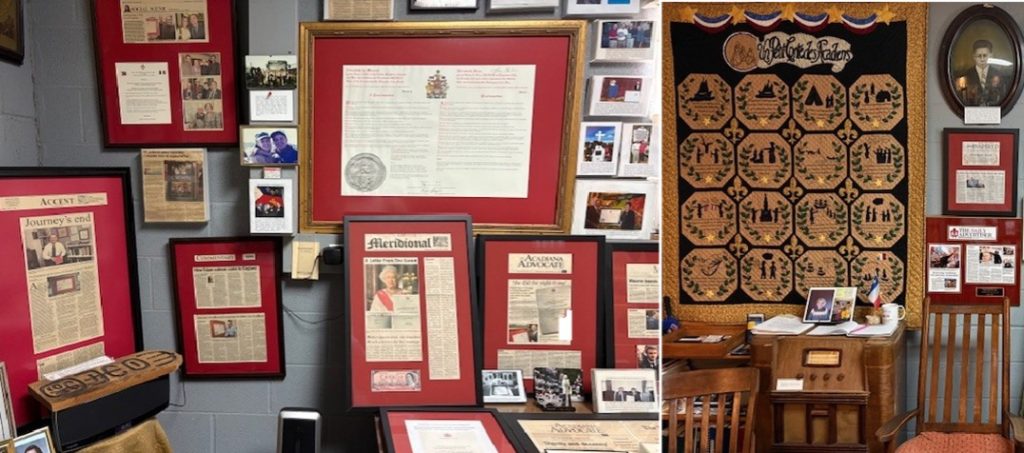
Photos by Jackie Labauve Vincent.
This room houses a copy of the Queen’s Royal Proclamation (2003), along with the original Petition for an Apology for the Acadian Deportation filed in 1990, plus letters from the Queen’s attorneys, research materials, artifacts and newspaper articles concerning the 15-year effort to obtain the official acknowledgment of wrongs committed by the British crown in carrying out the Acadian Deportation. The exhibit includes a letter from Queen Elizabeth II sent to the museum just eight days before she died, expressing her gratitude for the congratulations on her reign and thanks for the apology sent to her by Perrin. On display are many of the awards made to the Acadian Museum for its role in the preservation and promotion of Acadian heritage and culture, one that developed within North America and is viewed as a new ethnicity. The original Royal Proclamation is in the national Library and Archives Canada in Ottawa.
The Erath Room
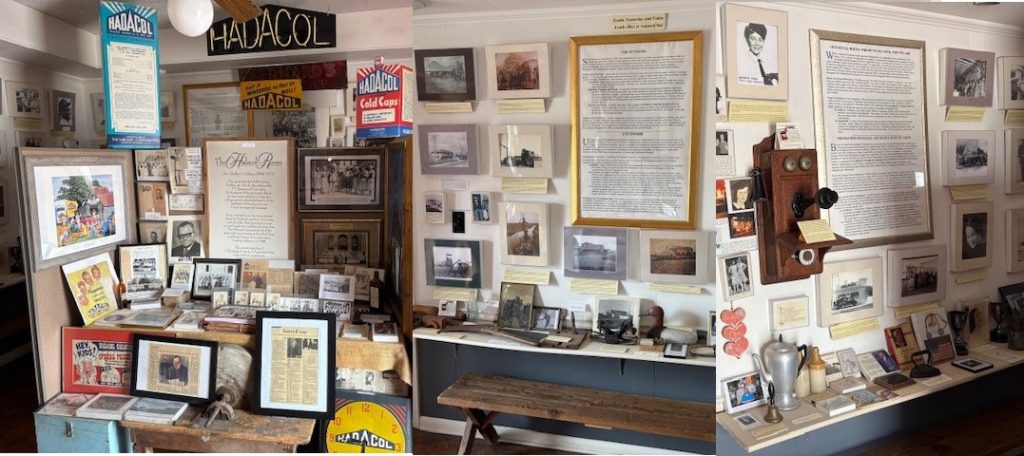
Photos by Jackie Labauve Vincent.
This room depicts the history of our hometown of Erath, LA in photographs with bilingual captions. One wall portrays the various economic developments that helped to build and sustain people of the Town of Erath and Vermilion Parish. Another portrays Erath’s interesting people, including Bernice Shiner Gera, who filed suit under the 1964 Civil Rights Act in order to be able to umpire a professional baseball game. She was the first woman to do so and she is enshrined in the Baseball Hall of Fame. Another exhibit features the life of Sen. Dudley J. LeBlanc Sr. (1894-1971), who developed and ceaselessly promoted the once-famous tonic known as Hadacol.
The Research Room
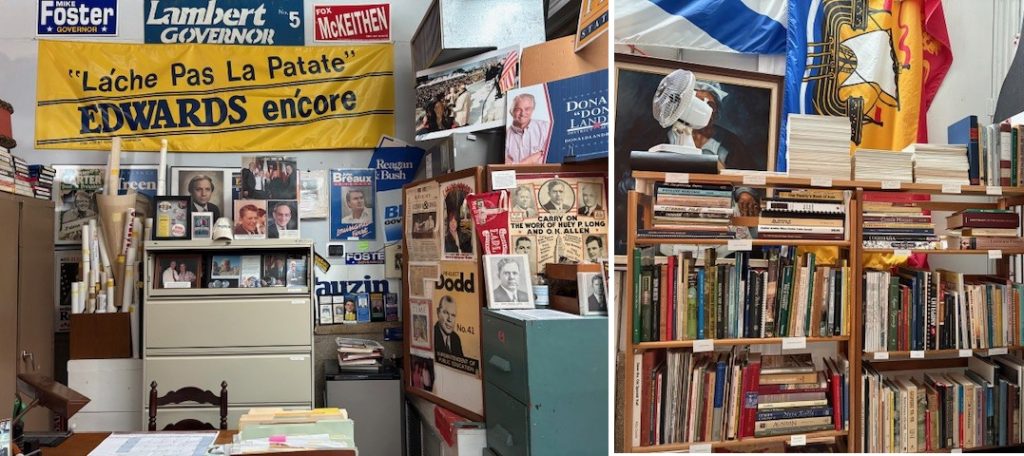
Photos by Jackie Labauve Vincent.
The Research Room includes over 2,000 DVDs, video tapes, recordings, books, genealogies and files dealing with Acadian history and genealogy. A cloth map shows the Spanish land grant given to the first Acadian settler in this area, circa 1780. Also displayed are the many posters and signs used by some of Louisiana’s most famous politicians in their elections. The large yellow sign was used by four-time Governor Edwin W. Edwards in his first campaign in 1971 using the line from a famous Cajun song by Jimmy C. Newman. The extensive research materials and cassettes are open and available to the public at no charge.